Airline Inventory

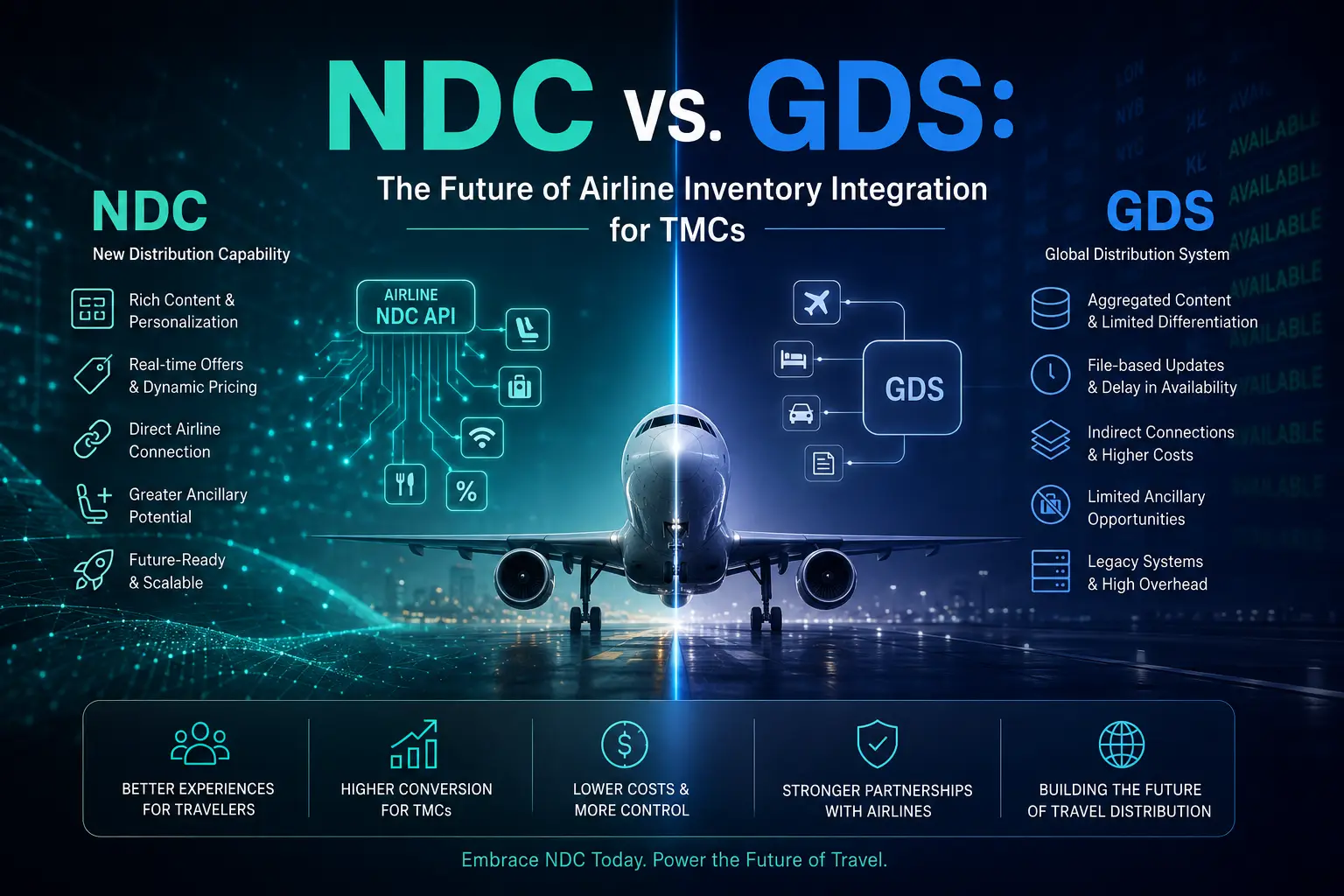
NDC vs. GDS: The Future of Airline Inventory Integration for TMCs

NDC is reshaping how airline inventory flows to travel management companies. Understanding the trade-offs is the difference between leading the shift and being left behind.

2 min read
Comparing NDC and GDS integrations for airlines

Airline distribution has been one of travel's slowest-moving battlefields. NDC has changed the pace — and the architecture of TMCs has to change with it.

#1What changed in airline distribution

Carriers want richer merchandising, dynamic offers, and a direct relationship with the corporate traveller. NDC provides the rails to do that. The result is a fragmented but more capable distribution landscape.

#2What NDC offers — and what it asks for

NDC lets airlines surface ancillaries, bundles, and dynamic offers with rich content. The cost: TMCs must integrate carrier by carrier and handle inconsistent implementations. The benefit, when it works, is a materially better travel experience.

#3Why GDS is not going anywhere yet

GDS remains the only place to obtain unified availability across a wide carrier set in one integration. For most TMCs the right answer is hybrid: NDC where it works well, GDS for breadth and back-office workflow.

#4How TMCs should architect for the transition

Build an offer abstraction layer that normalises NDC, GDS, LCC connectors, and direct connects into a single internal contract. Every booking flow consumes that contract — no UI code should know which channel an offer came from.


The takeaway

NDC is a generational shift in airline distribution. TMCs that build for hybrid distribution — with a clean internal contract — will turn the disruption into competitive advantage.

Frequently asked questions

Should TMCs integrate every carrier directly?
No. Direct-connect every carrier where the content and economic upside justifies it. Aggregators still earn their keep in long-tail coverage.
Will GDS players disappear?
Unlikely soon. They are evolving into orchestrators across NDC and traditional channels. The role changes; the relevance does not vanish.
Keep reading

Similar articles