Legacy Application Modernization: A Practical Roadmap for Business-Critical Systems
A practical guide to assessing, planning, and modernizing legacy applications without putting essential business operations at risk.
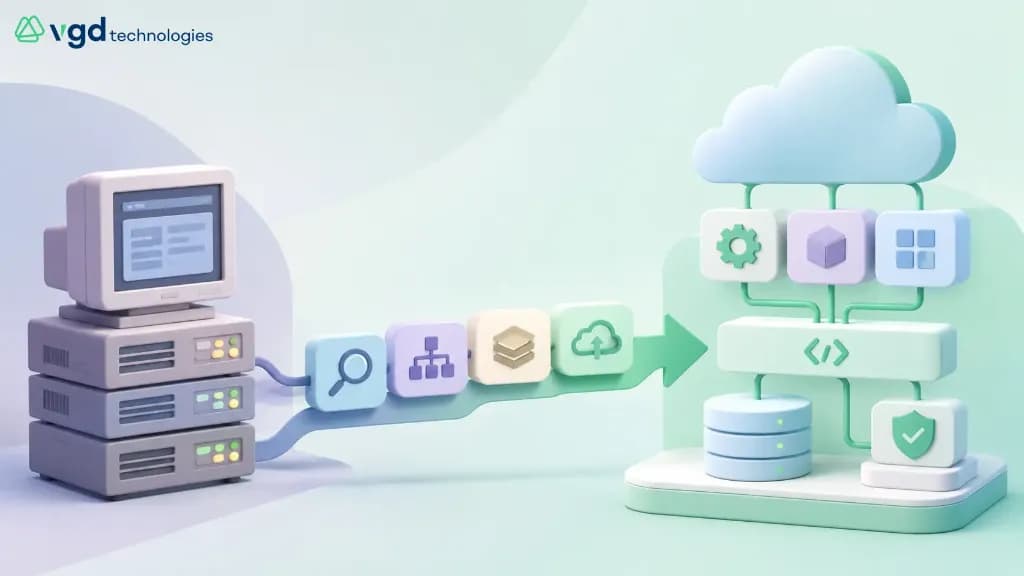
The software your business depends on may also be the software slowing it down. It still processes orders, stores customer records, manages finance, or keeps operations moving. People know how to use it, and vital business rules are buried inside it. Replacing it sounds risky, but leaving it untouched can make every new feature, integration, and security update harder than it should be.
That is the core challenge of legacy application modernization. The goal is not to replace old technology simply because it is old. The goal is to make a business-critical system easier to maintain, safer to operate, and ready for the strategic work your business needs to execute next.
A successful modernization effort begins with a fundamental business question, not a technology preference: what must become easier, safer, faster, or more cost-effective after the work is complete? A complete rewrite is only one possible path, and it is rarely the wisest starting point for every application.
#1What legacy application modernization actually means
Legacy application modernization is the process of improving an existing software system so it can support current business needs and future change. The work may involve updating the technology stack, restructuring the code, moving infrastructure, improving integrations, redesigning the database, strengthening security, or replacing parts of the user experience.
It does not always mean rebuilding the application from scratch. Legacy software modernization is often a programme of smaller changes rather than one replacement project. An enterprise operations platform in use for a decade may handle core transactions flawlessly, but suffer from slow reporting, manual data transfers, and no clean API layer. The solution is rarely a high-risk multi-year replacement, but a controlled sequence of targeted modular improvements.
- Infrastructure migration: Changes where the application runs, but does not solve architectural debt or code quality.
- Replatforming: Updates the runtime or platform with targeted improvements without full redesign.
- Code refactoring: Restructures internal code without breaking external user experience or behaviour.
- Architecture redesign: Establishes clear system boundaries, modular domains, and modern integration contracts.
- Database modernization: Redesigns schemas, storage, and access layers while protecting data integrity.
- Full replacement: Replaces legacy software with SaaS or a custom build when technical debt cannot be remedied.
#2How to know when a legacy system needs attention
Age alone is not a reason to replace software. A system can be old and still be stable, secure, affordable, and fit for purpose. The stronger signals are the operational bottlenecks and compounding risks that appear around it daily.
- Small changes take too long: Simple features require multiple teams, manual database adjustments, and extended maintenance windows. Developers hesitate to touch the code because side effects are unpredictable.
- Knowledge concentration: Only one or two veteran developers understand the application logic, unwritten exceptions, and legacy data structures, creating extreme key-person dependency.
- Unsupported tech stack: Runtimes, operating systems, frameworks, or third-party libraries have reached end-of-life (EOL), leaving systems unpatchable against modern vulnerabilities.
- Fragile integrations: Core workflows rely on manual spreadsheets, one-off batch scripts, and direct database writes that break whenever upstream services update.
- Performance ceilings: Batch jobs overrun their processing windows, real-time reports cause database locking, and the system cannot scale to handle new transaction volumes.
- Rising compliance & security exposure: Incomplete audit trails, weak identity controls, and unencrypted legacy protocols make compliance audits stressful and expensive.
#3Choose the right modernization strategy before choosing the technology
There is no universal modernization recipe. An effective strategy balances business criticality, technical debt, integration complexity, licensing costs, and operational lifespan across the 7 Rs framework:
- Retain: Keep stable, low-change systems in place while wrapping them in secure API boundaries.
- Retire: Safely decommission redundant or duplicate applications to reduce operational overhead.
- Rehost: Lift-and-shift workloads to modern cloud infrastructure to resolve immediate hardware or hosting deadlines.
- Relocate: Move platform workloads to cloud-hosted hypervisors without modifying configurations.
- Repurchase: Transition from custom-built non-core tools to specialized commercial SaaS platforms.
- Replatform: Upgrade underlying runtimes, containerize components, or adopt managed databases with minimal code edits.
- Refactor & Re-architect: Redesign monolithic codebases into decoupled, modular services using modern domain boundaries.
A rewrite should be the last resort. If business rules are critical but poorly documented, throwing away existing code before extracting and testing those rules will replicate old defects inside a newer technology stack.
#4Assess the existing system before planning the migration
A modernization roadmap is only as sound as the empirical discovery behind it. Before setting timelines or selecting target architectures, engineering leaders must develop a complete, unvarnished map of the existing estate:
- Map the application portfolio: Catalog every service, batch script, reporting database, scheduled cron job, and shadow system currently supporting business operations.
- Extract business rules: Interview operators and reverse-engineer embedded logic governing pricing, approvals, reconciliations, and compliance that may not be formally documented.
- Trace dependencies & data flows: Document which services call the application, where master data originates, and which external systems consume its outputs.
- Audit code maintainability & security: Profile test coverage, dependency vulnerability reports, database query bottlenecks, and disaster recovery readiness.
- Establish concrete baselines: Measure change lead time, incident frequency, MTTR, cloud spend, and manual workaround hours before writing a single line of replacement code.
#5How to modernize legacy systems in manageable phases
The safest modernization initiatives de-risk delivery through deliberate, incremental phases rather than a high-stakes 'big bang' cutover:
- Step 1: Clarify business outcomes — Tie every technical change directly to measurable KPIs like release cadence, uptime SLA, or infrastructure efficiency.
- Step 2: Complete exhaustive discovery — Uncover undocumented integrations, batch workflows, and shadow databases before finalizing targets.
- Step 3: Rank components by risk and value — Start with high-value, decoupled capabilities rather than tackling the most tangled core monolith first.
- Step 4: Establish the target architecture — Standardize API contracts, identity protocols, logging standards, and CI/CD quality gates across all delivery teams.
- Step 5: Modernize one vertical slice — Build, test, and release a single end-to-end capability to validate team velocity and integration patterns.
- Step 6: Execute validated data migration — Map schemas, automate reconciliation scripts, and rehearse rollback protocols using realistic production datasets.
- Step 7: Run parallel verification — Validate outputs between old and new systems concurrently to catch behavioral discrepancies before traffic flips.
- Step 8: Execute phased traffic cutover — Shift users incrementally using canary rollouts or feature flags with pre-agreed rollback triggers.
- Step 9: Decommission safely — Turn off legacy infrastructure only after auditing archive retention requirements, reporting pipelines, and disaster recovery access.
#6Modernize a monolith without turning the project into a risky rewrite
Monolithic systems become hazardous to evolve when unrelated business concerns share identical databases, execution threads, and deployment cycles. However, decomposing an application into dozens of microservices on day one often multiplies operational complexity.
A proven, battle-tested methodology is the Strangler Fig pattern: place an API facade or proxy in front of the monolith to intercept inbound traffic. As replacement modules are built and verified, the facade routes traffic away from the legacy core to the new services until the monolith is safely hollowed out.
- Establish clear bounded contexts with unambiguous domain responsibilities and explicit interfaces.
- Deploy an API gateway or reverse proxy to route traffic dynamically without altering client endpoints.
- Assign single-source data ownership to prevent split-brain updates across concurrent databases.
- Implement comprehensive distributed tracing and centralized logging to observe traffic across hybrid boundaries.
- Maintain automated rollback capabilities so failed releases can be reversed without customer disruption.
#7Treat database modernization as a separate engineering workstream
Code can be iteratively refactored, but business data cannot be recreated if corrupted. Financial records, compliance logs, historical audits, and transactional customer ledgers represent irreplaceable enterprise value.
Database modernization demands a dedicated engineering workstream addressing seven critical criteria:
- 1. Data profiling & hygiene: Identify orphan records, schema anomalies, and inconsistent date/currency formatting before ingestion.
- 2. Schema transformation: Map legacy relational tables to modern normalized schemas or event-driven storage patterns.
- 3. Dependency mapping: Audit all stored procedures, ETL pipelines, triggers, and BI dashboards that query the existing database.
- 4. Zero-downtime replication: Capture continuous changes using Change Data Capture (CDC) pipelines during migration windows.
- 5. Deep data reconciliation: Validate primary keys, foreign-key relationships, checksums, and aggregate financial totals rather than relying on surface row counts.
- 6. Safe dual-write management: Design resilient fallback reconciliation queues if dual-write patterns are used during cutovers.
- 7. Rehearsed rollback protocols: Establish point-in-time recovery points and tested restoration runbooks before any production migration.
#8Build security, privacy, and recovery into the modernization plan
Migrating to modern cloud platforms does not automatically guarantee security. Modernization creates new attack surfaces — such as exposed API endpoints, distributed microservice boundaries, and cloud IAM roles — that require deliberate defense-in-depth engineering.
- Zero-Trust Identity: Replace legacy hardcoded credentials with centralized OAuth 2.0 / OIDC and fine-grained Role-Based Access Control (RBAC).
- Data Protection: Enforce TLS 1.3 for all data in transit and AES-256 with automated key rotation for data at rest.
- Secrets Management: Move passwords, API keys, and certificates out of configuration files and into secure enterprise key vaults.
- Continuous Vulnerability Scanning: Automate container scanning, SAST/DAST checks, and software bill of materials (SBOM) tracking in CI/CD pipelines.
- Immutable Audit Logging: Centralize tamper-proof system logs to satisfy SOC 2, ISO 27001, HIPAA, and GDPR audit mandates.
- Automated Disaster Recovery: Conduct routine recovery drills with defined Recovery Point Objectives (RPO) and Recovery Time Objectives (RTO).
#9Use AI-assisted modernization carefully
Generative AI and automated code comprehension tools offer unprecedented speed when parsing legacy languages (COBOL, RPG, VB6, older Java), extracting implicit business rules, drafting documentation, and generating boilerplate unit tests.
However, AI-generated transformations and explanations are statistical hypotheses, not formal mathematical proofs. Engineering leadership must maintain rigorous human-in-the-loop verification:
- High-value AI applications: Explaining legacy syntax, drafting initial architecture documentation, suggesting edge-case test suites, and flagging dead code patterns.
- Mandatory human governance: Verifying complex business logic, reviewing security-critical authorization routines, validating data transformations, and approving production cutovers.
- Intellectual property & IP protection: Never paste proprietary business logic or regulated customer data into public AI models without vetted enterprise privacy agreements.
#10What does legacy application modernization cost?
There is no single flat fee for application modernization. Investment requirements reflect system scale, documentation debt, database volume, integration density, availability requirements, and regulatory stringency.
A complete Total Cost of Ownership (TCO) evaluation balances the direct modernization roadmap against the mounting cost of inaction:
- Discovery & architecture planning: Codebase audits, dependency mapping, risk matrices, and execution roadmaps.
- Software engineering: Refactoring, API construction, containerization, and replacement module development.
- Data engineering & migration: Cleansing, schema mapping, CDC replication pipelines, and reconciliation verification.
- Cloud infrastructure: Compute, storage, managed databases, networking, and observability tooling.
- Testing & QA automation: Regression suites, performance load profiling, penetration testing, and user acceptance drills.
- Change management & training: User documentation, internal operations training, and parallel-run overhead.
#11Common mistakes that make modernization harder
Large-scale modernization initiatives often stumble not from technical complexity, but from preventable strategic missteps:
- The 'Big Bang' rewrite fallacy: Committing to a multi-year parallel rebuild that delivers zero intermediate value and fails to keep pace with evolving business needs.
- Stopping at cloud migration: Treating lift-and-shift infrastructure relocation as the conclusion of modernization while leaving brittle architectures untouched.
- Premature microservices adoption: Swapping a straightforward monolithic application for a distributed system of dozens of microservices before establishing operational tooling.
- Overlooking batch jobs & reporting pipelines: Focusing exclusively on frontend user screens while neglecting nightly cron tasks, ETL scripts, and downstream data feeds.
- Indefinite parallel operations: Running legacy and replacement systems side-by-side without a firm decommissioning date, doubling maintenance costs and confusing operators.
- Measuring vanity metrics: Tracking lines of code migrated or containers deployed rather than release frequency, customer transaction velocity, and uptime reliability.
#12When should you not modernize a legacy application?
Modernization is an investment of capital and engineering bandwidth. Sometimes the most prudent, value-maximizing decision is to leave a system untouched.
Holding off on modernization is sensible when:
- The application is stable, secure, and fully satisfies its dedicated operational function with minimal maintenance intervention.
- The system is scheduled for planned business retirement within the upcoming 12 to 24 months.
- An existing commercial off-the-shelf (COTS) or SaaS product cleanly satisfies the business requirement without requiring custom software development.
- The system has hard hardware, physical interface, or air-gapped regulatory dependencies that prohibit cloud migration or code changes.
The takeaway
Legacy application modernization is not an arbitrary tech refresh. It is a strategic business initiative designed to make core applications resilient, secure, maintainable, and adaptable to future market demands.
Start with the business outcomes that matter. Audit the current architecture, map dependencies, and extract valuable business rules before touching code. Modernize in manageable, vertical slices, validate data transfers relentlessly, and build automated security and rollback mechanisms into every phase.
A disciplined modernization journey delivers far more than modern syntax: it provides your business with an agile, high-performing foundation capable of scaling with confidence.
Frequently asked questions
- What is legacy application modernization?
- Legacy application modernization is the process of improving an existing software system so it can meet current business needs. It may involve updating the platform, refactoring code, redesigning architecture, migrating data, improving integrations, strengthening security, or replacing selected components.
- What are the signs that a legacy system needs modernization?
- Common signs include slow and risky releases, unsupported technology, rising maintenance effort, fragile integrations, performance problems, security gaps, poor documentation, and reliance on a small number of people who understand the system.
- What is the difference between legacy system migration and modernization?
- Migration moves an application or workload to another environment. Modernization changes how the system is built, maintained, integrated, secured, or used. A migration can be one part of modernization, but moving an application without changing it does not automatically solve its architectural or operational problems.
- What are the main legacy application modernization strategies?
- Common strategies include retaining, retiring, rehosting, relocating, repurchasing, replatforming, and refactoring or re-architecting an application. The right choice depends on business value, technical condition, dependencies, risk, and future requirements.
- What is the difference between replatforming and refactoring?
- Replatforming moves an application to a different platform or runtime and may include targeted improvements. Refactoring changes the internal code structure while preserving intended behaviour. Re-architecting goes further by changing how the application is organised and how its components work together.
- Can a legacy application be modernized without downtime?
- A carefully planned phased approach can reduce or avoid user-visible downtime, but zero downtime should not be promised without understanding the system. The result depends on architecture, data dependencies, cutover design, testing, and rollback options. Some systems may still require a short maintenance window.
- How long does legacy application modernization take?
- The timeline depends on the number of applications and modules, code quality, data complexity, integrations, business availability requirements, and the chosen strategy. A focused replatforming effort may take much less time than a multi-stage enterprise re-architecture. A discovery assessment is needed before a credible timeline can be estimated.
- How much does legacy application modernization cost?
- Cost depends on discovery, engineering effort, data migration, infrastructure, integrations, testing, training, parallel operation, and ongoing support. The estimate should compare the total cost of keeping the current system with the cost and expected business value of the proposed changes.
- Should a business rewrite or modernize its existing software?
- A rewrite may make sense when the existing architecture cannot support required changes and the business rules are well understood. Modernizing in stages is often safer when the current application still supports important operations. The decision should follow an assessment of code, data, dependencies, risk, and business priorities.
- Can a monolithic application be modernized one module at a time?
- Yes. Incremental replacement can move selected capabilities into new components while the rest of the monolith continues to operate. This requires clear interfaces, routing, data ownership, monitoring, and rollback plans so the old and new parts work together during the transition.
- Is microservices architecture always the best choice for modernization?
- No. Microservices can help when separate capabilities need independent deployment, scaling, or ownership. They also add operational complexity. A modular monolith may be a better choice when the system does not need distributed services or the team is not ready to operate them.
- How can a business protect data during legacy database migration?
- Start with data profiling, ownership, schema mapping, and dependency discovery. Test migration scripts with representative data, validate important fields and relationships, reconcile totals, protect access, maintain backups, and rehearse rollback. Record which system is authoritative during each stage of the transition.
- Can AI help with legacy code modernization?
- AI can assist with code discovery, documentation drafts, dependency investigation, test-case suggestions, and selected code transformations. Engineers must verify the results against real business behaviour, security requirements, licensing, and production tests. AI output should not be treated as an authoritative description of an undocumented system.
- Does legacy modernization require cloud migration?
- No. Some systems benefit from moving to cloud infrastructure, while others may be better suited to a different hosting model or may need to remain where they are. The decision should consider security, data residency, performance, dependencies, operating costs, and business requirements.
- What role do APIs play in legacy application modernization?
- APIs can provide controlled interfaces between an existing application and newer web, mobile, or enterprise systems. They can reduce direct dependencies and allow selected capabilities to be replaced over time. API design should include authentication, authorization, validation, versioning, monitoring, and clear ownership of data.
- How do you measure whether a modernization project has succeeded?
- Compare the system against baselines agreed before the project. Useful measures include release lead time, incident frequency, response time, recovery time, infrastructure and support cost, integration reliability, manual effort, and user task completion. The measures should reflect the business outcome, not just the amount of code changed.
- How should a business choose a legacy modernization partner?
- Look for a team that begins with discovery, can explain the trade-offs between migration and modernization strategies, understands data and integration risks, plans incremental delivery, and includes testing, security, rollback, and post-launch support. Ask how the team will measure outcomes and how it will protect business continuity during the work.
Similar articles
 FinTech & Banking
A CTO's Guide to Migrating Legacy Banking Cores to Microservices
Banking core migrations fail more often than they succeed. The path that does work is incremental, evidence-driven, and treats the monolith with respect.
 Education & EdTech
The Role of Custom LLMs as Personalized AI Tutors
Personalised AI tutors are now a credible product, but generic LLMs hit a ceiling fast. Here is what changes when you build the model around the curriculum.
 Mobile Development
AI-First iOS App Development: On-Device AI, App Intents & Foundation Models
A practical guide to building AI-first iOS products with on-device intelligence, Foundation Models, App Intents, SwiftUI, and a production-ready mobile architecture.