#1What is an AI-powered chatbot?
An AI-powered chatbot is software that interprets user messages (text or voice), infers intent, and responds in context — often by combining language models with business rules, APIs, and curated knowledge. Unlike static FAQ widgets, modern systems handle paraphrasing, follow-up questions, and multilingual traffic, but they still need human oversight for regulated industries.
- Customer service: order status, troubleshooting, returns, and policy guidance.
- Sales and marketing: product discovery, booking, promotions, and lead capture.
- Internal ops: IT helpdesk, HR policy navigation, and field technician knowledge retrieval.
#2Business case: support, sales, and operations
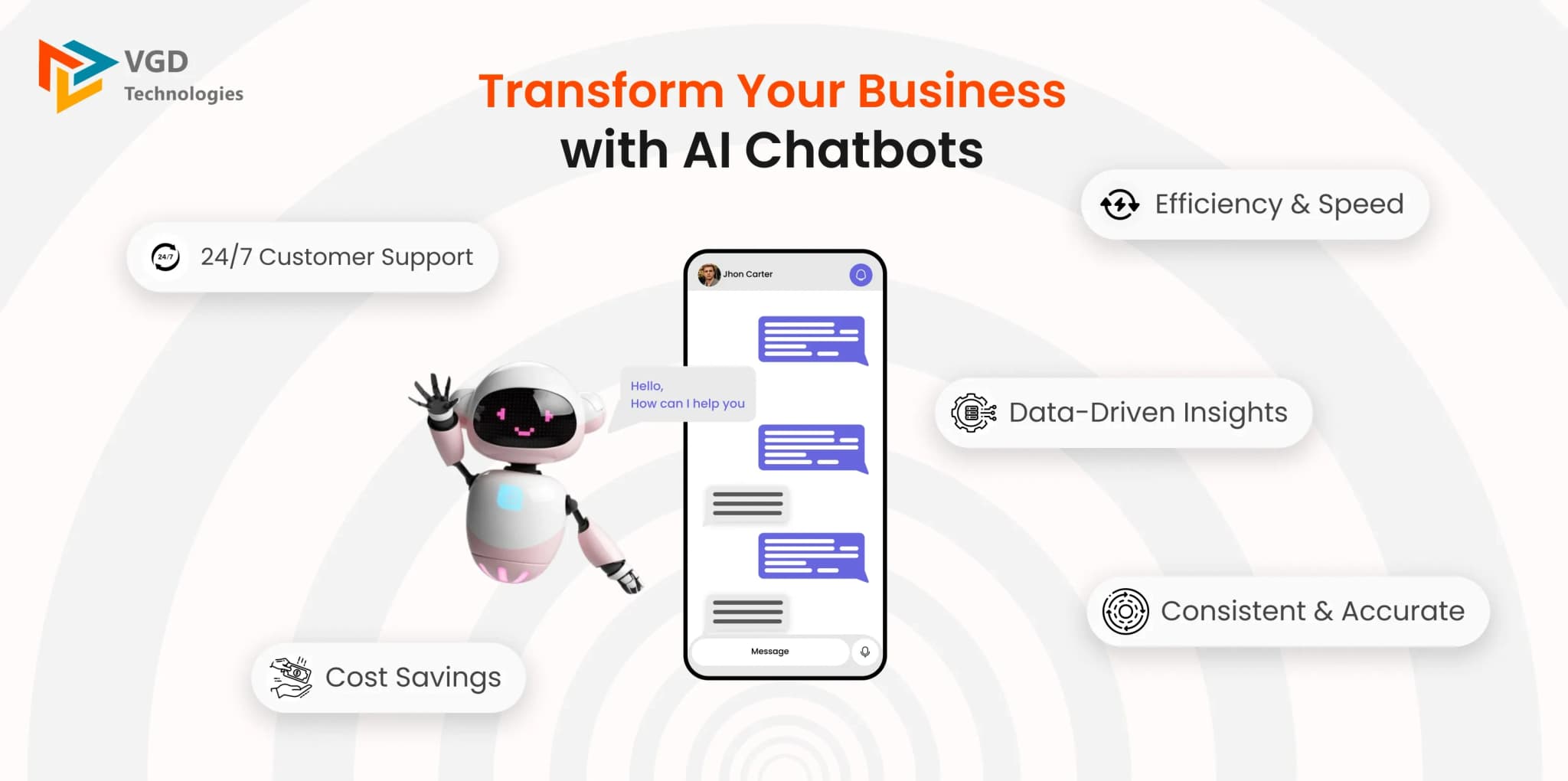
The strongest chatbot programmes tie automation to measurable outcomes: average handle time, first-contact resolution, cart recovery, or qualified pipeline per conversation hour. Start with high-volume, low-risk intents — password resets, WISMO (“where is my order?”), store hours — then expand into revenue flows once monitoring proves accuracy.
- 24/7 coverage without linear headcount growth (especially across time zones).
- Consistent answers that follow approved scripts and compliance language.
- Structured transcripts for analytics: top friction points become product backlog inputs.
- Omnichannel deployment: website, app, WhatsApp, and social inboxes with one orchestration layer.
#3Architecture types: rule-based, retrieval, and generative
Rule-based and retrieval-based chatbots map user intents to curated responses — excellent when answers must be exact (banking fees, healthcare triage disclaimers, warranty terms). Generative LLM layers add flexibility for open-ended questions but require guardrails: citation to source documents, refusal policies, PII redaction, and evaluation suites that track regression after every model or prompt change.
Retrieval-augmented generation (RAG) is the default pattern for enterprise knowledge: chunk documents, embed them, retrieve the top passages, then ask the model to answer only from that context. This improves factual grounding compared with “prompt the model and hope” while still sounding natural.
- Retrieval-based: FAQs, policy manuals, SKU catalogues — optimise for precision.
- Task-oriented: bookings, payments hand-offs, ticket creation — optimise for deterministic APIs.
- Generative + tools: complex research summaries with human review — optimise for safety and latency budgets.
#4Implementation playbook from prototype to production
- Define scope: channels, languages, authentication, and escalation paths to human agents.
- Inventory content: help articles, macros, transcripts — then label intents and edge cases.
- Prototype flows: happy path first, then cancellation, anger, and “I want a human” branches.
- Integrate systems: CRM, OMS, ticketing, identity — with least-privilege service accounts.
- Evaluate continuously: golden questions, user thumbs, reviewer spot checks, and drift monitoring.
- Launch with shadow mode or partial traffic, then expand as quality thresholds hold.
#5Cost, quality metrics, and safety guardrails
Cost drivers include token volume, speech recognition, human review queues, and integration complexity. Quality metrics should blend automation rate with customer satisfaction — a bot that closes tickets quickly but infuriates users is a net loss. Safety means rate limits, injection resistance, audit logs, and clear disclosures when users interact with AI.
VGD Technologies helps teams design pragmatic conversational AI: channel strategy, model selection, secure integrations, and hardening for production — whether you need a focused retail assistant or an enterprise orchestration layer across tools.